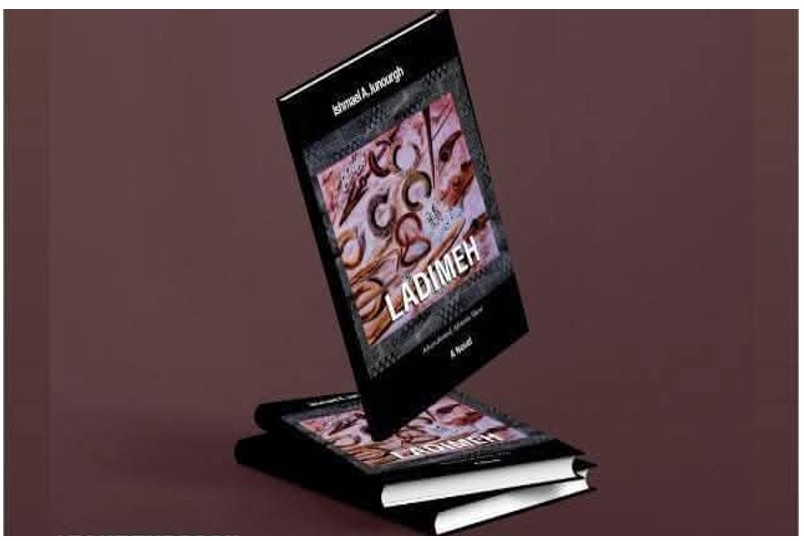
Ladimeh is the story of a young boy whose life is shattered by slavery. As an infant still breastfeeding, Ladimeh experiences violence for the very first time when raiders attack his village. In a desperate attempt to save him, his mother hides him beneath her large breasts, a haunting image that captures both maternal protection and the terror of destruction.
The novel by Ishmael Junourgh Abudu follows a young boy whose humanity is tested in a world shaped by violence, betrayal, displacement, and abandonment. Despite the cruelty surrounding him, Ladimeh struggles to preserve his identity, memory, and sense of self in a system designed to strip him of all three.
The book weaves a narrative about how Ladimeh was assimilated into the family into which he had to serve as what can be termed African slavery, away from Buulu his ancestral home. But the condour of the story is also that it indicated the complication of the assimilative posture of pre-industrial societies. It provides how Ladimeh, who though had demonstrated himself as a man of worth, was still subject to internal discrimination in social matters, including whom he could marry and whether he could even become a major political figure. It further demonstrates that in Africa context of slavery a person in servitude was still held as a human being, not as merchandised material who died socially or what Orlando Patterson called social death.
Ladimeh does not portray slavery merely as a historical event or the transportation of people in chains. Instead, the novel humanizes slavery through the lived experiences of its protagonist. It reveals slavery as the destruction of identity, the loss of family, cultural dislocation, emotional trauma, and the painful severing of belonging.
Before destruction arrives, the novel carefully portrays African life in its fullness, its culture, dignity, traditions, systems, and humanity. This is significant because it prevents Africans from being seen only as victims of slavery. The people in the story are presented as individuals with thriving communities, histories, and civilizations long before violence interrupts their lives.
Through Ladimeh’s journey, readers encounter the brutal realities of enslavement: forced movement, hunger, exhaustion, fear, beatings, uncertainty, and constant humiliation. Yet beyond the physical suffering, the novel focuses deeply on the psychological damage caused by slavery. The enslaved are stripped not only of freedom, but also of identity, memory, dignity, and belonging.
Ultimately, Ladimeh is a deeply emotional exploration of survival, humanity, and resilience in the face of unimaginable suffering. The novel reminds readers that slavery was not only a physical system of oppression but also a deliberate assault on the human spirit.
About the Author
 Ishmael A. Junourgh is currently a graduate student of the Institute of African Studies, IAS, University of Ghana, Legon, Accra. He obtained a Bachelor of Arts in Communications, journalism option, from the African University College of Communications in Accra. He believes he is a reincarnation of his griot and griottess ancestors, Kisabla Gyedu Juru Buburwu and Buburwu Diatah.
Junourgh took his ancestral calling as griot, a step further from oral tradition to writing. Most of his books were sociocultural, sociohistorical and anthropological inclined.
He is famous for his fond statement: “Before my great grandfather passed on, he gave me two things, and that is a needle kibasibi and a thread jesei and these needle and thread are symbolic of the indigenous storytelling techniques and so I use this indigenous storytelling techniques as my needle and thread to knit my stories”.
His debut novel, “Not Forsaken: Diaries of an African Child” came out in 2019. And became an instant international seller. In 2022, his second novel, “Ancestors Prologue: Diaries of an African Child” followed and became an international seller, too. In 2024, he released “Ladimeh: Abandoned African Slave” and it became an instant international seller.